

Mental Compulsions: The OCD Symptom Nobody Talks About
When most people picture OCD, they picture the visible stuff. Hand washing. Checking the locks. Straightening the pens.
But some of the most exhausting compulsions are completely invisible. They happen entirely inside your head, sometimes for hours a day, and nobody around you has any idea. Not even, often, you.
These are mental compulsions, and they're one of the most misunderstood parts of OCD. People who mainly have mental compulsions frequently go years without recognizing what's happening, because they've been told compulsions are things you do with your hands.
Compulsions are things you do, period. Some of them just don't leave the building.
What Counts as a Mental Compulsion
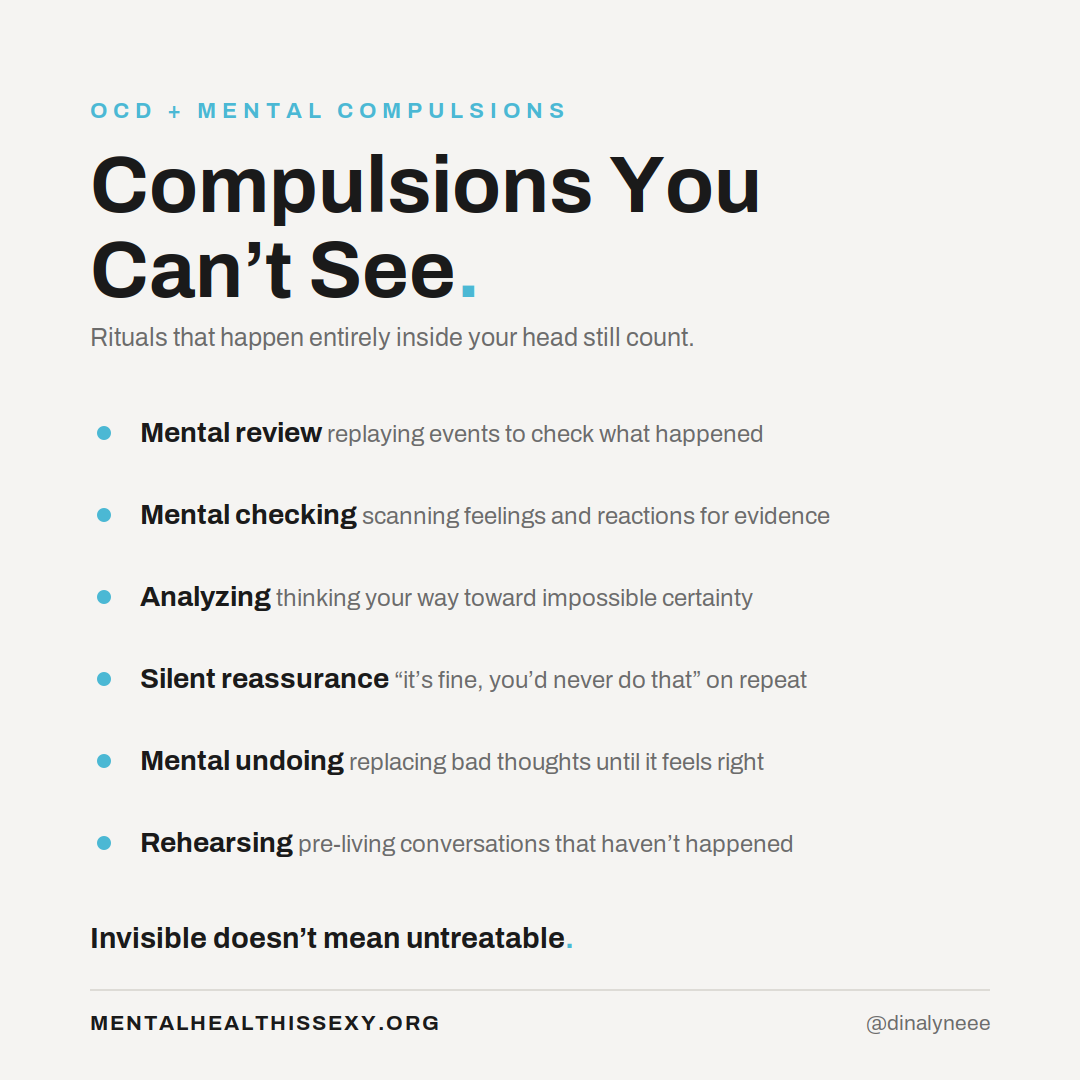
A compulsion is any repetitive act performed to relieve the anxiety of an obsession or to prevent a feared outcome. Mental compulsions do that job silently. The most common ones I see in my practice:
Mental review. Replaying events, conversations, or your own actions to check whether something bad happened, whether you did something wrong, or whether you're the kind of person your obsession accuses you of being. Did I offend them? Did I actually lock it? Did I mean that thought?
Mental checking. Scanning your body, your feelings, or your reactions for evidence. Checking whether you're anxious, whether you felt the "wrong" feeling, whether the intrusive thought produced a reaction.
Rumination and analysis. Trying to think your way to certainty about an unanswerable question. What if I don't really love my partner? What if that thought means something about me? The analyzing feels like working toward an answer. It's the compulsion itself.
Silent reassurance. Telling yourself "it's fine, you would never do that, remember that time you proved it" on repeat. Comfort on a loop stops being comfort and starts being a ritual.
Mental undoing. Replacing a "bad" thought with a good one, repeating phrases or prayers, counting, mentally redoing something until it feels right.
Rehearsing. Running future conversations or scenarios over and over to feel prepared enough for something that hasn't happened.
If you read that list and felt seen five different ways, you're exactly who this post is for.
Why Mental Compulsions Fly Under the Radar
Three reasons.
They masquerade as thinking. Analysis feels virtuous. Reviewing feels responsible. Our culture practically worships "thinking things through," so a compulsion dressed up as deep thought gets a free pass for years.
They're involuntary-feeling. Because they happen fast and internally, they feel like something happening to you rather than something you're doing. But there's always that split second of choice, the moment the obsession shows up and you reach for the ritual. That reach is the behavior.
Even clinicians miss them. Someone describes constant intrusive thoughts but "no compulsions," and gets told they have "pure O," purely obsessional OCD. Here's the thing most people with that label discover: the compulsions were there all along, they were just mental. Truly compulsion-free OCD is vanishingly rare. If you look closely at what happens in the seconds after the obsession, you almost always find the ritual.
This matters because the treatment targets the compulsion. If you can't see it, you can't treat it.
The Loop Is the Same, Visible or Not
Obsession, anxiety, compulsion, relief, repeat. Mental compulsions run the identical cycle as physical ones. The relief after a mental review or a silent reassurance is real, and that relief is precisely what teaches your brain the obsession was a genuine threat requiring a response. Every review confirms the case needed reviewing.
Which is also why mental compulsions grow. What started as a quick check becomes an hour-long tribunal. The loop always demands more.
How ERP Treats Mental Compulsions
Exposure and response prevention works on mental compulsions the same way it works on washing or checking, with one adjustment: the response prevention has to happen inside your head, which makes it a noticing skill first.
In practice: the obsession shows up, and instead of reviewing, analyzing, reassuring, or undoing, you allow the thought and the uncertainty to remain exactly as they are. Unanswered. Unresolved. Uncomfortable. That's the exposure. Declining the mental ritual is the response prevention.
It's genuinely hard at first, and it genuinely works. I wrote a full breakdown of how response prevention applies to repetitive thinking, and the five-step skill in my guide to stopping rumination is the same muscle. If you want to practice it in a structured way, my workbook This Isn't a Spiral walks you through it step by step. For mental compulsions tied to OCD, though, I'll be direct: working with an ERP-trained therapist is worth it. Mental rituals are slippery, and a good specialist will catch the ones you can't see yet. As someone who treats this every day, watching people get their hours back is the best part of my job.
Is This You?
If you're reading this wondering whether your "overthinking" is actually OCD with mental compulsions, a few pointers. The distress level matters: OCD obsessions feel sticky, intrusive, and often ego-dystonic, meaning they attack what you care about most. The time matters: mental rituals that eat an hour or more a day are a flag. And the doubt matters: OCD famously demands a certainty that never arrives.
My OCD screener quiz takes a few minutes and gives you a scored result. It's not a diagnosis, but it's a solid first signal about whether talking to a specialist makes sense.
Your thoughts were never the problem. The rituals are, and rituals can be retired.
FAQ
What is "pure O" OCD?
Pure O is shorthand for purely obsessional OCD, where compulsions aren't visible. The name is misleading. In almost every case, compulsions are present but mental: reviewing, checking, reassuring, analyzing. The treatment is still ERP, targeted at those internal rituals.
Are mental compulsions the same as rumination?
They overlap heavily. Rumination is repetitive, unproductive thinking. In OCD, rumination usually functions as a mental compulsion performed in response to an obsession. Outside OCD, rumination runs the same loop and responds to the same skill: response prevention.
Can you stop mental compulsions on your own?
You can absolutely build the noticing and response prevention skills yourself, and many people meaningfully reduce their rituals that way. If OCD is in the picture, an ERP specialist accelerates everything, because mental compulsions are easy to miss without trained eyes on the pattern.
