What Is Response Prevention for Rumination? A Therapist Explains
If you've heard of response prevention at all, it was probably in the context of OCD. It's the RP in ERP, exposure and response prevention, the gold standard treatment for obsessive compulsive disorder.
But here's what most people don't know: response prevention works on rumination too. Even if you don't have OCD. Because rumination runs on the exact same engine as a compulsion, and response prevention is how you turn that engine off.
I always say ERP is a way of living. It's a lifestyle shift. This post is about what that actually means when the compulsion is happening entirely inside your head.
First, What Response Prevention Actually Means
In classic OCD treatment, it works like this. An obsession shows up (a fear, a doubt, an intrusive thought) and creates anxiety. The compulsion is whatever you do to relieve that anxiety: washing, checking, confessing, seeking reassurance. The relief is real but temporary, and it teaches your brain that the obsession was a real threat and the compulsion was necessary. So the cycle repeats, stronger.
Response prevention means exactly what it sounds like: you prevent the response. The obsession shows up, the anxiety spikes, and you don't perform the compulsion. You let the anxiety be there, unanswered. Over time, your brain learns two things: the feared outcome doesn't materialize, and the anxiety fades on its own without the ritual. The obsession loses its power.
Now Swap in Rumination
Rumination follows the identical structure. Watch:
The obsession: an unresolved thought. The conversation that went weird. The decision you might have gotten wrong. The "what if" about your health, your relationship, your future.
The anxiety: the itch of unresolvedness. The feeling that you cannot move on until this is settled.
The compulsion: the ruminating itself. Analyzing, replaying, reviewing, mentally arguing, rehearsing. It's a behavior, just an invisible one.
The relief: the brief moment where the analysis feels productive, or where you land on a temporary "it's probably fine." That relief is the payment. It's why the loop returns.
Once you see rumination as a compulsion, the treatment becomes obvious. You don't need better answers. You need to stop performing the response.
What Response Prevention for Rumination Looks Like
Physical compulsions are easier to prevent because they're visible. You can see yourself walking back to check the stove. Mental compulsions are sneakier, which means response prevention for rumination is mostly a noticing skill. Here's the practice:
Step 1: Learn your onset signal. Rumination has a beginning. There's a moment where the thought arrives and you feel the pull to start working on it. It feels urgent, like a task. Your first job is just to catch that moment more often. You'll miss it constantly at first. Normal.
Step 2: Label without engaging. "This is rumination." Four words, then nothing. Not "this is rumination, but let me just quickly confirm one thing." That's the compulsion wearing a trench coat.
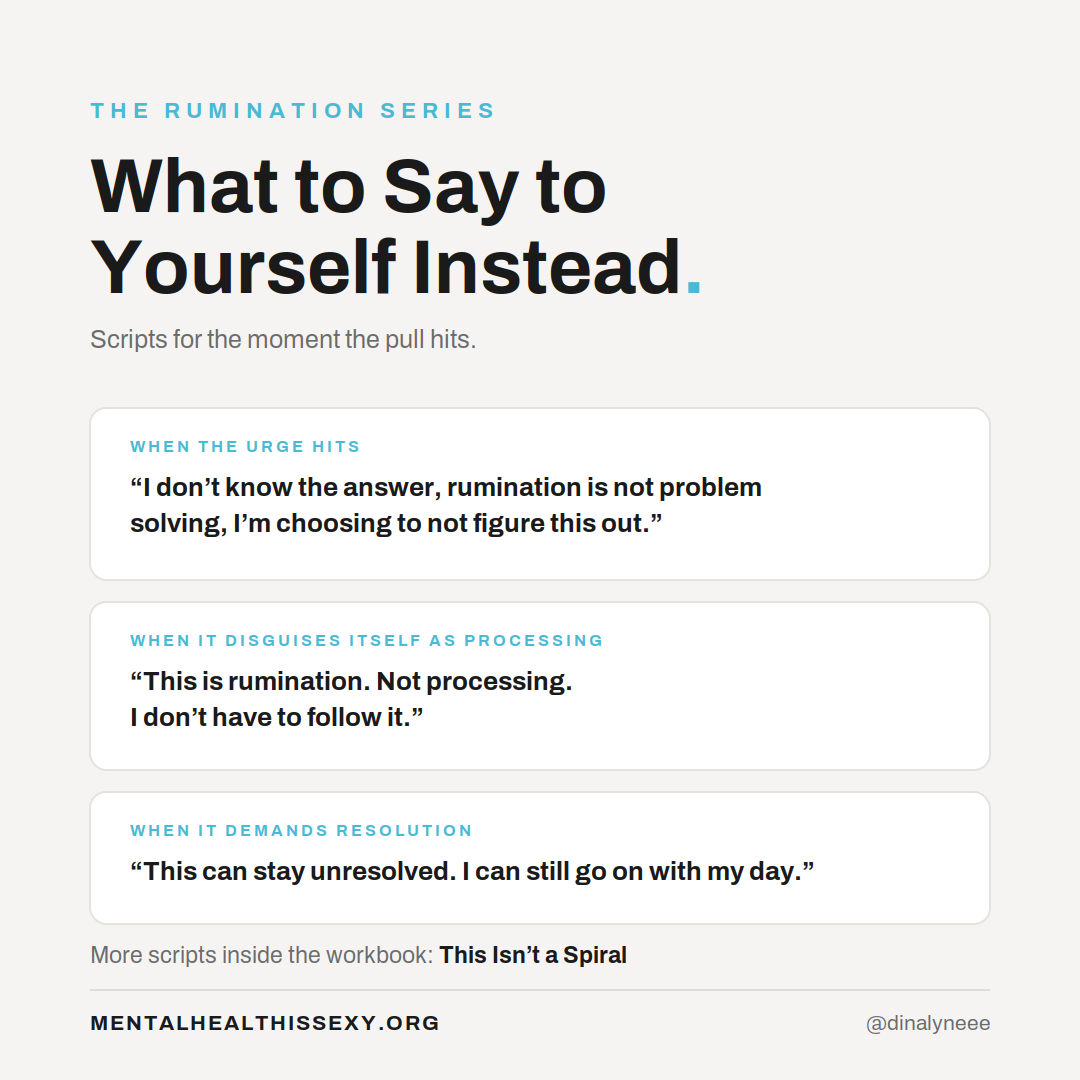
Step 3: Prevent the response. Don't analyze. Don't replay. Don't argue with the thought. And don't suppress it either, because pushing thoughts away is also a response, and it backfires. The thought gets to exist. You're just not working on it. One script I give clients: "I don't know the answer, rumination is not problem solving, I'm choosing to not figure this out."
Step 4: Redirect your attention to the present, gently, repeatedly. Back to the dishes, the email, the conversation in front of you. Your attention will snap back to the thought within seconds. Every single return is a rep. This is the workout.
Step 5: Allow the unresolved feeling. This is the exposure half of the equation. The discomfort of an open loop is exactly what you're learning to tolerate. It will fade. Not instantly, but reliably.
I wrote a full walkthrough of these steps with more detail in my main guide on how to stop ruminating, if you want the expanded version.
The Two Mistakes Everyone Makes
Mistake one: using response prevention to make the thought go away. If you're doing the steps while secretly monitoring whether the thought has left yet, that monitoring is itself engagement. The goal is not a quiet mind. The goal is a different relationship with the noise. The quiet comes later, as a side effect.
Mistake two: making exceptions for "important" thoughts. Your brain will argue that this particular worry is different, this one actually needs solving right now. Here's the test I trust: real problems come with available actions. If there's an action, schedule it and take it. If there's no action, it's rumination, no matter how important it feels. Importance is not the measure. Actionability is.
How Long It Takes
Expect the urge to spike for the first week or so. That's extinction burst, the brain protesting when a reliable reward stops paying out. It's uncomfortable and it's also evidence the method is working. Most people notice loops shortening within two to four weeks of consistent practice. The thoughts don't vanish. They just stop being sticky.
Where to Go From Here
If you want structure, my workbook This Isn't a Spiral turns this entire framework into a step-by-step practice, with worksheets for mapping your loops and building the skill daily.
And if your rumination comes with intense intrusive thoughts, rituals, or fears you can't shake, take my OCD screener quiz, because full ERP with a specialist might serve you better than self-help, and it works beautifully.
The response is the part you control. That's not a small thing. That's the whole thing.
FAQ
Is response prevention the same as thought stopping?
No, and this matters. Thought stopping tries to block or banish the thought, which backfires because suppression makes thoughts rebound. Response prevention lets the thought exist and targets what you do about it. The thought stays, the ritual stops.
Can I do response prevention without a therapist?
For everyday rumination, yes, many people build the skill on their own with structure and consistency. If rumination is tied to OCD, trauma, or is severely affecting your functioning, working with an ERP-trained therapist will get you further faster.
Does response prevention work for anxiety in general?
The principle applies broadly. Any time relief-seeking behavior is feeding an anxiety loop, whether that's reassurance seeking, googling symptoms, or avoiding, reducing the response weakens the loop. That's why ERP-style approaches show up across anxiety treatment.
