

How to Stop Ruminating: Why Distraction Doesn't Work (And What Does)
You know the loop. Something happens, or something might happen, or something happened six years ago, and your brain grabs it and will not let go.
You replay the conversation. You analyze what you should have said. You run the scenario forward, backward, sideways. You tell yourself you're "processing" or "figuring it out."
Hours later you have no answer. You just feel worse.
That's rumination. And if you've tried to stop by distracting yourself, thinking positive, or telling your brain to knock it off, you've probably noticed something frustrating. It doesn't work. Sometimes it makes the loop louder.
Here's why. And here's what actually helps.
Rumination Is Not a Thinking Problem. It's a Doing Problem.
This is the piece almost nobody tells you.
Rumination feels like something that happens to you. Thoughts just show up, right? But there are actually two parts to the loop, and only one of them is automatic.
The first part is the intrusive thought. The memory, the worry, the "what if." That part you don't control. Brains generate thoughts constantly. That's their whole job.
The second part is what you do with the thought. The analyzing. The replaying. The mental reviewing. The searching for certainty. That part is a behavior. A mental one, but a behavior.
In clinical terms, rumination functions like a compulsion. You engage with the thought because engaging feels productive, or because it briefly relieves the anxiety of leaving something unresolved. That little hit of relief teaches your brain that the thought was important and the engaging was necessary. So your brain serves up the thought again. And again.
You're not stuck in the loop because your brain is broken. You're stuck because engaging is being rewarded.
Why Distraction Doesn't Stop Rumination
Distraction sounds reasonable. Thought shows up, you redirect to something else, problem solved.
Except distraction sends your brain the same message that ruminating does: this thought is dangerous and I cannot be around it. You're still treating the thought like a threat. You're still responding to it. You've just swapped one response for another.
And your brain notices. Thoughts you run from come back stronger. This is one of the most reliable findings in anxiety research, and it's the same principle behind exposure-based treatment supported by the International OCD Foundation. "Just think about something else" has never once worked for you long term, and this is why.
Positive thinking has the same issue. Arguing with the thought, reassuring yourself, proving the worry wrong. It's all engagement. It all keeps the loop fed.
How to Stop Ruminating With Response Prevention
Response prevention comes from ERP, the gold standard treatment for OCD. I always say ERP is a way of living. It's a lifestyle shift. And it applies beautifully to rumination, even if you don't have OCD.
The idea is simple. Not easy, but simple. You stop performing the response.
The thought shows up. You notice it. And you do not engage. No analyzing. No replaying. No arguing. No reassuring. No distracting either. You just let the thought sit there, unanswered, while you keep doing whatever you were doing.
Here's what that looks like in practice:
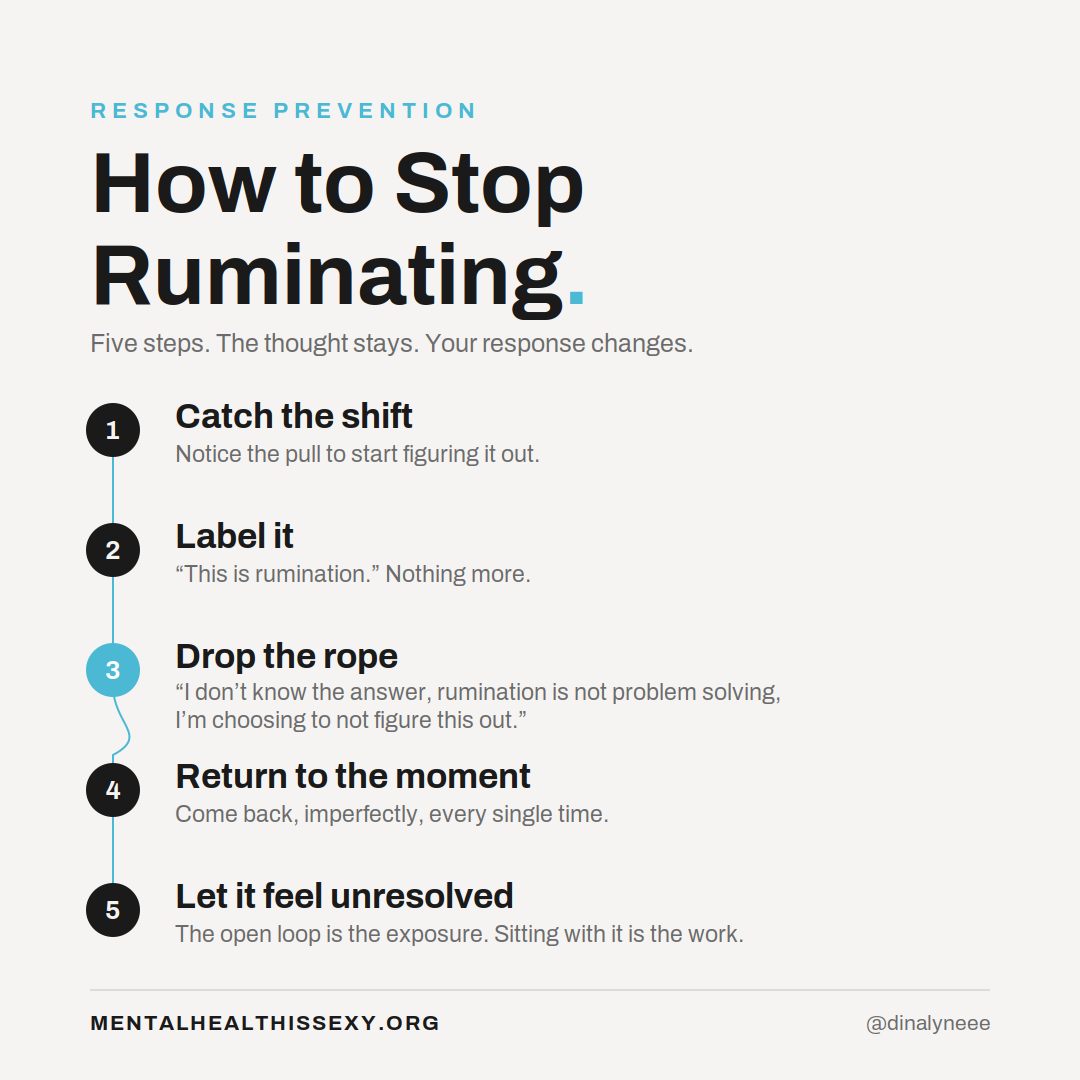
1. Catch the shift. Rumination has a moment of onset. A thought arrives and you feel the pull to start working on it. Learning to notice that pull is the skill. It feels like an itch, an urgency, a "wait, I need to figure this out first."
2. Label it. Quietly name what's happening. "This is rumination." Not "this is important" or "this is me processing." Just, rumination. Labeling creates a tiny gap between you and the loop.
3. Drop the rope. This is the response prevention part. You don't push the thought away and you don't pick it up. Imagine the thought is holding one end of a rope, inviting you to tug. You let your end fall. The thought can stay in the room. You're just not playing.
4. Return to the moment, imperfectly. Bring your attention back to what you were doing. Your attention will get yanked back to the thought within seconds. That's normal. That's not failure. Every single time you notice and drop the rope again, you're retraining your brain.
5. Let it feel unresolved. This is the hardest part and the most important. Rumination promises resolution. Response prevention asks you to tolerate not having it. The discomfort of an open loop is the exposure. Sitting with it is where the change happens.
Rumination vs. Problem Solving: "But What If I Actually Need to Think This Through?"
Fair question. Some thinking is problem solving. Some thinking is rumination wearing a productivity costume.
Here's a quick test. Real problem solving moves toward an action. It has a next step. It ends. Rumination circles. It asks unanswerable questions. Why did I say that. What if it means something. What if I can't handle it. It can run for hours and produce nothing you can do.
If you've been "thinking it through" for more than a few minutes and there's no action on the table, you're not solving. You're spiraling.
What to Expect When You Stop Ruminating
The first week of response prevention usually feels worse before it feels better. The urge to ruminate spikes when it stops getting fed. That spike is actually a good sign. It means your brain noticed the rules changed.
Stay with it. Within a few weeks most people notice the thoughts still show up, but they lose their grip faster. The loop gets shorter. The urgency fades. Eventually the thought arrives and it's just... a thought. Annoying, maybe. But not a full afternoon lost.
If You Want a Structured Way to Do This
I wrote a whole workbook on exactly this process. It's called This Isn't a Spiral and it walks you through identifying your rumination patterns, catching the pull in real time, and building the response prevention skill step by step. It's the same framework I use with my clients, in a format you can work through on your own.
Your thoughts are not the problem. What you do with them is. And that part, you can change.
Say how you feel, it's sexy :)
FAQ: Stopping Rumination
What triggers rumination?
Common triggers include unresolved conflict, uncertainty about the future, perceived mistakes, and social interactions you wish had gone differently. But the trigger matters less than the response. Rumination continues because engaging with the thought gets rewarded with brief relief, regardless of what started it.
Is rumination a symptom of anxiety or OCD?
It shows up in both, plus depression. In OCD, rumination often functions as a mental compulsion. In anxiety and depression, it tends to look like worry loops or replaying the past. Response prevention helps across all of them because it targets the behavior, not the diagnosis.
How long does it take to stop ruminating?
Most people notice the loops getting shorter within two to four weeks of consistent response prevention practice. The thoughts don't disappear, and that's not the goal. What changes is how quickly you can drop the rope and move on.
