

Rumination vs. Problem Solving: How to Tell the Difference
"I'm not overthinking. I'm figuring it out."
I hear this from clients constantly. And honestly, it's a fair defense, because rumination and problem solving feel identical from the inside. Both involve turning something over in your mind. Both feel important. Both feel like work.
But one of them moves your life forward and the other quietly eats your afternoons. Here's how to tell which one you're doing.
The 30-Second Test
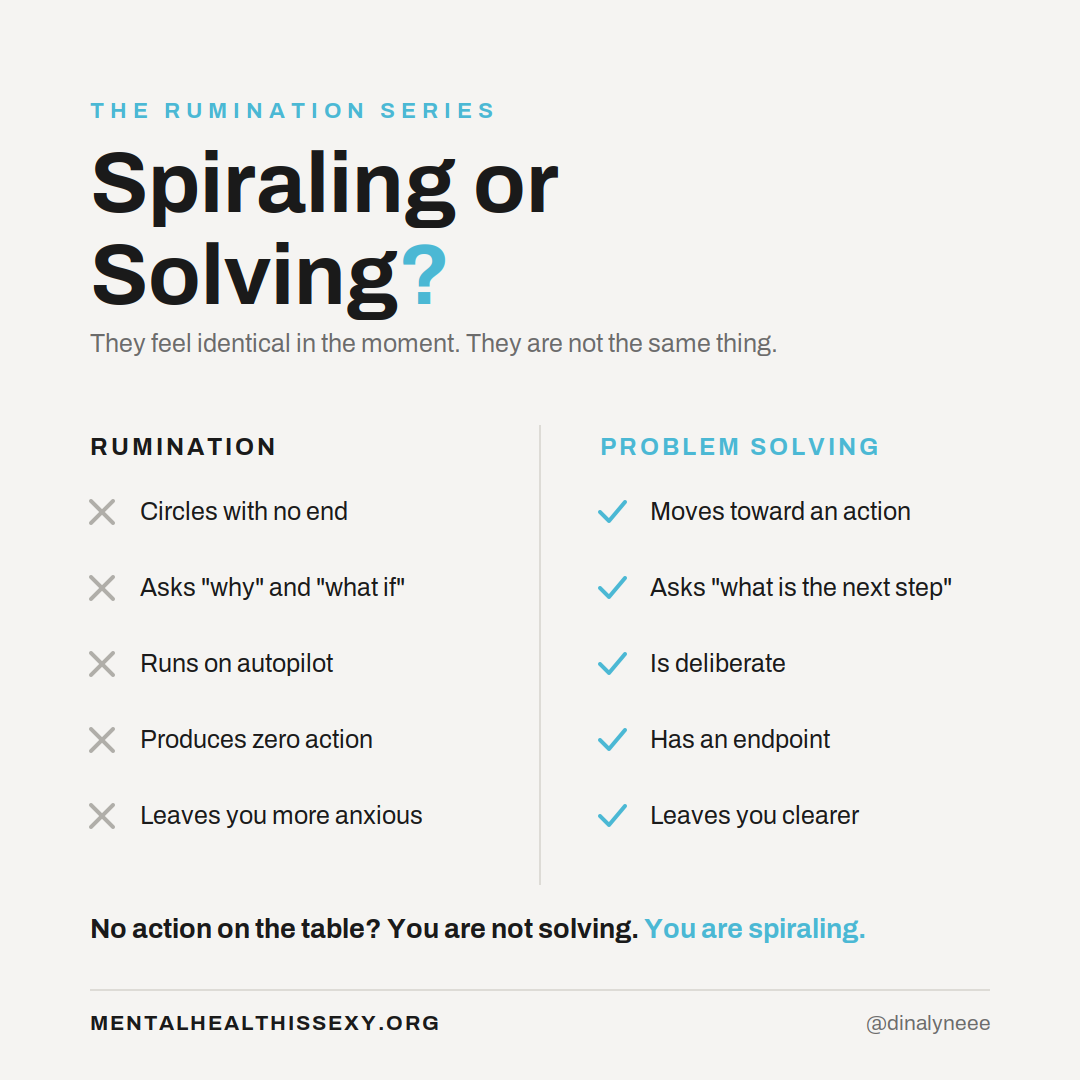
Ask yourself one question: is there an action on the table?
Problem solving moves toward something you can do. It has a next step. Book the appointment. Send the email. Ask the question. Make the list. When the action becomes clear, the thinking ends, because the thinking did its job.
Rumination doesn't produce actions. It produces more rumination. You can run the loop for three hours and come out the other side with nothing you can actually do, just a vague sense that you need to keep thinking.
If you've been "thinking it through" for more than a few minutes and no action has appeared, you have your answer.
Five More Ways to Tell Them Apart
1. The questions are different. Problem solving asks answerable questions: what are my options, what happens if I do X, what's step one. Rumination asks unanswerable ones: why did I say that, what if it means something, what if I can't handle it, why am I like this. If the question has no possible final answer, your brain can chew on it forever. That's the point. That's what keeps the loop running.
2. One is deliberate, one is automatic. Problem solving is something you sit down and do. Rumination is something you find yourself doing. You didn't decide to spend your shower replaying Tuesday's meeting. It just happened. Again.
3. One has an endpoint. Problem solving ends when you reach a decision or an action. Rumination ends when something interrupts it, and then it picks back up later like a podcast resuming where you paused.
4. Check how you feel afterward. Problem solving usually leaves you clearer, even if the situation is hard. Rumination leaves you more anxious, more foggy, and often more convinced the problem is unsolvable.
5. Rumination loves the past and the unanswerable future. Problem solving works on things that are actually in front of you. Rumination replays conversations from 2019 and rehearses disasters that haven't happened.
Why This Distinction Matters So Much
Because the treatment is completely different.
If it's a real problem, you problem-solve it. Make the decision, take the step, done.
But if it's rumination, more thinking is not the answer. More thinking is the compulsion. Rumination functions like a mental compulsion: engaging with the thought gives you a brief hit of relief or a feeling of productivity, which teaches your brain the thought was important and serves it up again. I wrote a whole post on how to stop ruminating using response prevention, but the short version is this: you treat the urge to ruminate the way you'd treat any compulsion. You notice it, you name it, and you don't perform it.
One of my favorite scripts to hand clients: "I don't know the answer, rumination is not problem solving, I'm choosing to not figure this out."
Saying that and meaning it is a skill. It feels wrong at first, like you're being irresponsible. You're not. You're refusing to do fake work.
A Note on the Gray Area
Sometimes a real problem and a rumination loop share the same topic. Your finances might genuinely need attention AND be the subject of a 2am spiral. Here's how I handle that with clients: schedule the problem solving. Literally put it on the calendar. "Saturday, 10am, 30 minutes, look at the budget and pick one action." Then any thinking about it outside that window gets labeled as rumination and dropped.
If your brain protests that this is urgent and can't wait until Saturday, that protest is usually the anxiety talking, not the problem.
If You Want to Go Deeper
My workbook This Isn't a Spiral walks you through mapping your own rumination patterns and building the drop-the-rope skill step by step. It's the framework I use with clients, in a self-paced format.
Your brain is going to keep offering you fake work. You get to decline.
FAQ
Is rumination the same as overthinking?
Mostly, yes. Overthinking is the casual term, rumination is the clinical one. Both describe repetitive thinking that circles without producing action. The key feature is the loop, not the topic.
Can rumination ever be productive?
The honest answer is no, and that's actually what defines it. The moment repetitive thinking produces a decision or an action, it was problem solving. If it circles without an endpoint, it's rumination, no matter how productive it feels.
Why does rumination feel so necessary?
Because engaging with the thought briefly relieves the anxiety of leaving it unresolved. That relief teaches your brain that the thinking was important. It's a reward loop, and it's why the pull feels so convincing.
