Why You Can't Stop Replaying Conversations in Your Head
The conversation ended hours ago. Maybe days ago. Everyone else involved has completely forgotten it.
You have not.
You've replayed it in the shower, on the drive, while pretending to watch TV. You've analyzed your tone. You've drafted the thing you should have said. You've studied their face in your memory like it's security footage.
If this is you, nothing is wrong with you. This is one of the most common forms of rumination there is, and it has a very specific mechanism. Once you see it, you can interrupt it.
Why Conversations, Specifically
Social interactions are the perfect fuel for rumination for three reasons.
They're ambiguous. You can never fully know what someone thought of you. Did that pause mean something? Were they annoyed? There's no answer key. And your brain treats missing information about social standing as a threat worth solving.
They're unchangeable. The conversation already happened. Which means every replay is your brain attempting to problem-solve something that has no available action. That's the definition of rumination: thinking that can't produce a next step. I broke down the difference between rumination and problem solving in another post, and social replay fails the test every time.
They involve other people's minds. Humans are wired to care intensely about how we're perceived. Your brain isn't being dramatic, it's running ancient social survival software. It's just running it on a two-minute exchange with a barista.
The Replay Loop, Step by Step
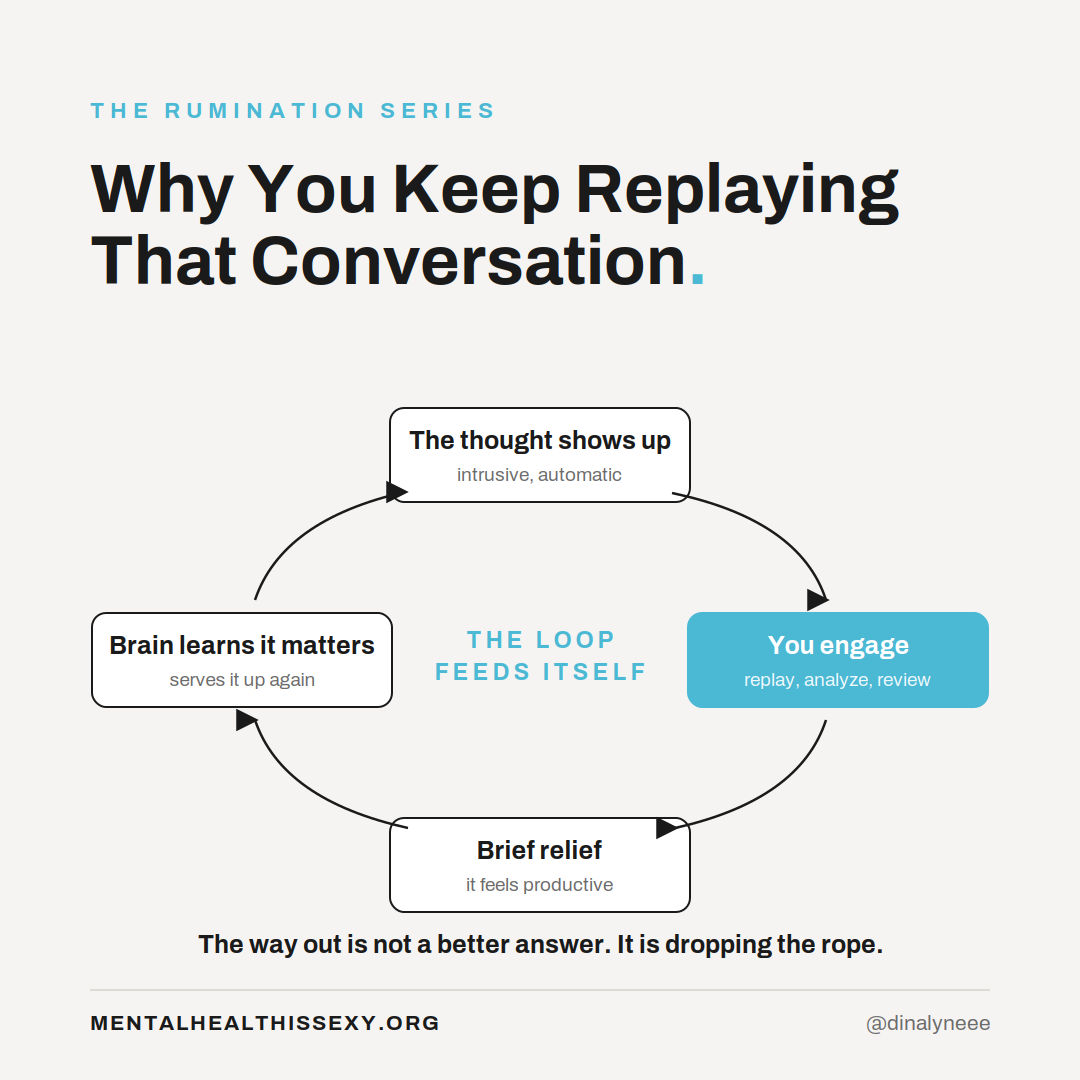
Here's what's actually happening each time:
The memory surfaces. Automatic, uninvited.
You feel a spike of discomfort. Embarrassment, uncertainty, the cringe.
You engage. Replay it, analyze it, rewrite it.
For a moment, engaging feels productive. Maybe this pass will settle it. Sometimes you even get a few seconds of relief: "okay, it probably wasn't that bad."
That relief is the trap. It teaches your brain that replaying was useful and the memory was important.
So your brain serves it up again. Louder.
The replay is not processing. The replay is a mental compulsion, and every repetition feeds it.
Why "Figuring Out What It Meant" Never Works
Because the question is unanswerable. You cannot retrieve certainty about another person's private impression of you. There's no amount of analysis that produces it. So the search never ends, it just exhausts you.
And here's the part that stings a little: the replaying doesn't even improve your future conversations. It makes you more self-conscious in the next one, which creates more ambiguous moments, which gives you more material to replay. The loop generates its own supply.
What Actually Ends the Loop
Response prevention. The same skill used to treat compulsions in OCD, applied to the replay.
The memory will still show up. You can't control that part, and trying to block it backfires. What you control is the second step: whether you pick it up.
When the replay starts, try this:
Name it. "This is a replay." Not "let me just check one thing about it." Naming it interrupts the autopilot.
Refuse the case. You are not going to solve what they thought of you, because it's not solvable. Say the line: "I don't know how that came across, and I'm choosing to not figure this out."
Return to now, imperfectly. Go back to whatever you were doing. The memory will yank at you again within a minute. Expected. Every time you decline the replay, you're retraining the loop.
Let the cringe be there. The discomfort of not resolving it is the exposure. It fades on its own when you stop feeding it. I walk through the full five-step version of this skill in my guide to stopping rumination.
The first few days of this feel worse. The urge spikes when it stops getting paid. Then, for most people, the replays start losing their grip within a couple of weeks. The memory shows up, gets named, and leaves. Like a notification you swipe away instead of a case file you reopen.
When It's More Than a Habit
If replaying and analyzing takes up hours of your day, feels impossible to resist, or comes with intense fear about what the replays might mean, it's worth looking at whether this is part of a bigger pattern like OCD or social anxiety. Mental review is a classic mental compulsion, and it responds really well to proper ERP treatment. My OCD screener quiz is a good place to start if you're wondering.
And if you want a structured way to build the skill on your own, my rumination workbook This Isn't a Spiral covers replay loops in depth, including the social ones.
That conversation is over. You're the only one still in the room. You're allowed to leave too.
FAQ
Why do I replay conversations at night?
Because night removes all the competition. No tasks, no noise, no distractions, just you and your brain's open loops. Fatigue also weakens the part of your brain that would normally redirect attention, so replays run longer and hit harder after dark.
Is replaying conversations a symptom of anxiety?
It shows up strongly in social anxiety, generalized anxiety, and OCD, where it's called mental review. But plenty of people without a diagnosis do it too. What matters is the mechanism, and the fix is the same: stop performing the replay.
How do I stop cringing at old memories?
You stop the behavior, not the memory. Cringe memories fade when they stop getting reviewed. Name the replay, decline to analyze it, let the discomfort sit unresolved, and the memory loses its charge over time.
